Sunday, April 20, 2014

Remove Smart Guard Protection-Malware Security Suite

Smart Guard Protection Properties


Smart Guard Protection is a rogueware which is also called fake anti-virus program. Such program filches the interface and copy the content as well as functions of the genuine anti-virus program. In other word, Smart Guard Protection doesn’t possess those functions, it simply displays that it has them and that’s all. Therefore, paying it and getting its so called advanced version will not help with detected threats or harms.

By cheating PC users into paying it, Smart Guard Protection manages to get easy money. But one should also be clear that there’s another way to get easy money for extra income: collect the input information on the counterfeit registration page and resell it to other operators who long for contact details so as to deliver sales letters and messages.


Smart Guard Protection Troubles

Friday, April 18, 2014

What Are We Supposed to Do Against Heartbleed Bug - CVE-2014-0160 (OpenSSL Exploit)?


Heartbleed Bug Outline


Heartbleed Bug was firstly found on the last Friday when Antti Karjalainen and other colleagues were updating the functionality of Codenomicon’s test components. Heartbleed bug belongs to zero day exploit, which indicates that the bug has long been existent or known by some technicians who are paid to find some man-made bug for Internet companies.

The moment Heartbleed bug was reportedly to be found, concerns over information security are aroused among the mass as more and more people become prone to store important documents online – Cloud. And now professionals and Internet operation staff are working hard to repair and fix heartbleed bug before hackers develop it. Meanwhile, Codenomicon company has bought the URL “heartbleed.com” to offer some detail information and the latest report on the OpenSSL Exploit.


Some Security Issues about Heartbleed Bug


In sum, Heartbleed bug occurs in the implementation code when OpenSSL is compiling TLS(Transport Layer Security)’s RFC6520. Due to the omissions in bounds checking, the hacker/attacker is enabled to access and quest, without privilege or authentication, for the data that can be up to 64KB stored someplace besides in memory.

The data can be:

[Expert Guide] Worm:VBS/Jenxcus.K Can Be Removed, How?


Worm:VBS/Jenxcus.K Is IntrusiveThe establishment of computer network system was objective to share data information and external resources, which also constructs favorable environment for virus like Worm:VBS/Jenxcus.K to live and spread.

Worm:VBS/Jenxcus.K is a worm that exploits vulnerability within VBScript. In web environment, the worm would increase exponentially to aggravate traffic burden and thus result in a dead network system within a short period of time. This indicates that the worm is a network worm. From a scientific point of view, it is much more intrusive than Trojan horse:

Thursday, April 17, 2014

Remove Strong Trojan Win32/Spy.Zbot.YW that Steals Paswword


Trojan Win32/Spy.Zbot.YW Troubles

  1. Considerably consumed CPU.
  2. Snail-like PC performance.
  3. Error message would be triggered to cause malfunction/dysfunction.
  4. Freezes/crash would happen on both computer and browsers.
  5. Additional infections or unknown items can be detected soon after its infiltration.
Not all the above listed troubles will be detected by a victim. It depends on the level of privileges. Win32/Spy.Zbot.YW will inject itself into one of two services. If the account has administrative privileges, the threat injects itself into the winlogon.exe service. If not, it attempts to do the same with the explorer.exe service. The threat also injects code into svchost.exe service, which it later uses when stealing banking information. There more privileges the Trojan gets, the more services will be affected to fall into its use, and the more troubles will be incurred.


Where Win32/Spy.Zbot.YW Comes from?


Q: Supposedly the alert about Win32/Spy.Zbot.yw came up once the computer was turned on and Outlook opened and nothing else was done. Then where the infection would have come from if not from some clickable link in an email or a webpage?

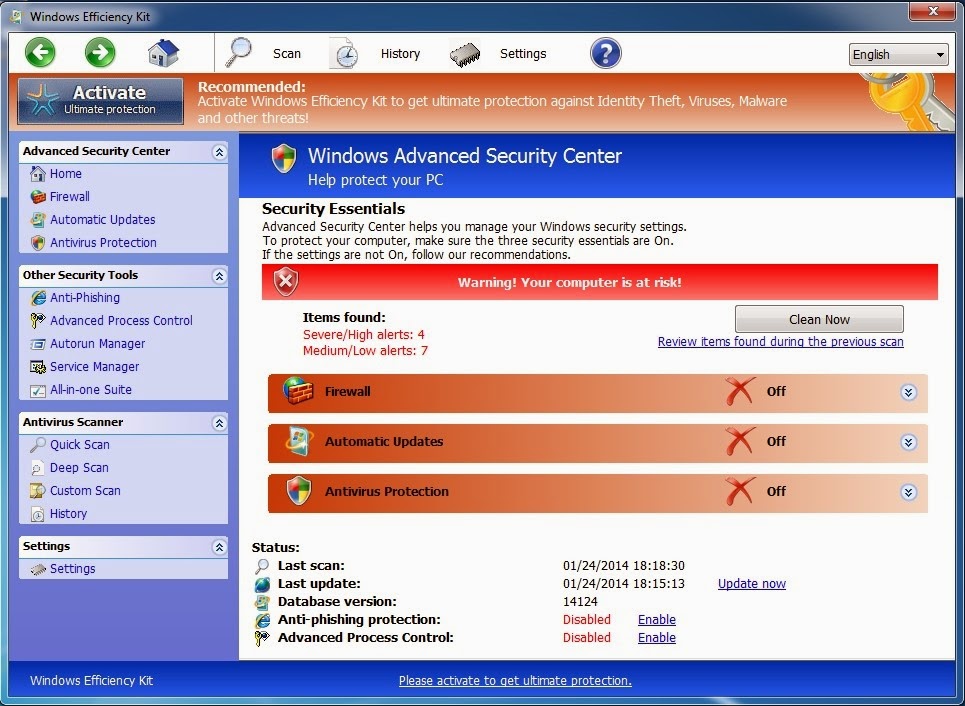
Windows Efficiency Kit, Remove Fake Anti-Virus Program


Windows Efficiency Kit has grown into a notorious rogueware that many victims try hard to remove it without avail. Usually, the utility that most victims try to remove such fake anti-virus program is anti-virus program and “Add/Remove”. But these are destined to fail since Windows Efficiency Kit has disabled security services as well as utilities and it manages to stay on a machine even when there’s no appearance in “Add/Remove”. Let’s keep reading and see how dangerous the rogueware is.


How Dangerous Is Windows Efficiency Kit


The dangers mainly lie in the vulnerable computer after its infiltration and information theft. As a rogueware, Windows Efficiency Kit is adept at taking advantage of vulnerability/bug/loophole and backdoor for propagation. When it is done, the internal system components can be easily overwritten and modified maliciously, especially the ones associated with security services and utilities. This is how installed anti-virus program start to stop working, no more automatic update and no access to the reputable web sites offering security services. With out-of-gear security defense, the affected computer will become readily to be exploited by other infections such as Exploit:JS/Neclu.M.

Then how Windows Efficiency Kit manages to steal confidential information, and what exactly the confidential information is?